
Safety
Ladder or scaffold: when may you work from a ladder?
· 5 min read
This explains the rules that apply in the Netherlands and Belgium.
In the law a ladder is mainly a way to get somewhere. As a workplace it is only allowed when the risk is low, and then only for short work or when the location allows nothing else. The Dutch construction sector makes that concrete: under 5 metres standing height, under 2 hours for the whole job, little force, within arm's reach and below wind force 6.
What the law says
Article 7.23 of the Dutch Working Conditions Decree limits ladders and stepladders as a workplace at height to situations where a safer means is not justified because the risk is low, and where in addition:
- the work is short, or
- the location has features you cannot change, for example because there is no room for a scaffold.
So it is low risk and short or unavoidable. That a ladder is cheaper than other equipment does not count as a reason; Arbouw says so in as many words in its guidance for construction workers. In Belgium almost the same rule is in article IV.5-4 of the Code on well-being at work.
The concrete limits from construction
The law names no metres or hours. The construction sector has worked them out. Arbouw, the Dutch construction sector's occupational health and safety institute, uses this table in its guidance:
| What you look at | Ladder allowed | Discuss first | Ladder not allowed |
|---|---|---|---|
| Standing height (where your feet are) | under 5 m | 5 to 7.5 m | over 7.5 m |
| Time on the ladder for the whole job | under 2 hours | 2 to 4 hours | over 4 hours |
| Time on the ladder per person, added up | over 1 hour | ||
| Force you apply, such as pushing or drilling | under 50 N | 50 to 100 N | over 100 N |
| Reach | within arm's length | beyond arm's length |
On top of that: at wind force 6 or more you do not go up a ladder. More on that in ladders and wind.
"Discuss first" means the supervisor and the worker decide together whether extra measures make it acceptable. It is not a free pass. And 50 newtons is roughly the force needed to lift 5 kilos; drilling into concrete or pushing hard against a ceiling quickly goes beyond that.
And the fifteen minutes?
You often hear that you may work for at most a quarter of an hour from one position. That number is not in the Dutch decree. It is a rule of thumb used in practice and in sector guidance. Our article on the 15-minute rule explains how to apply it.
Which equipment instead?
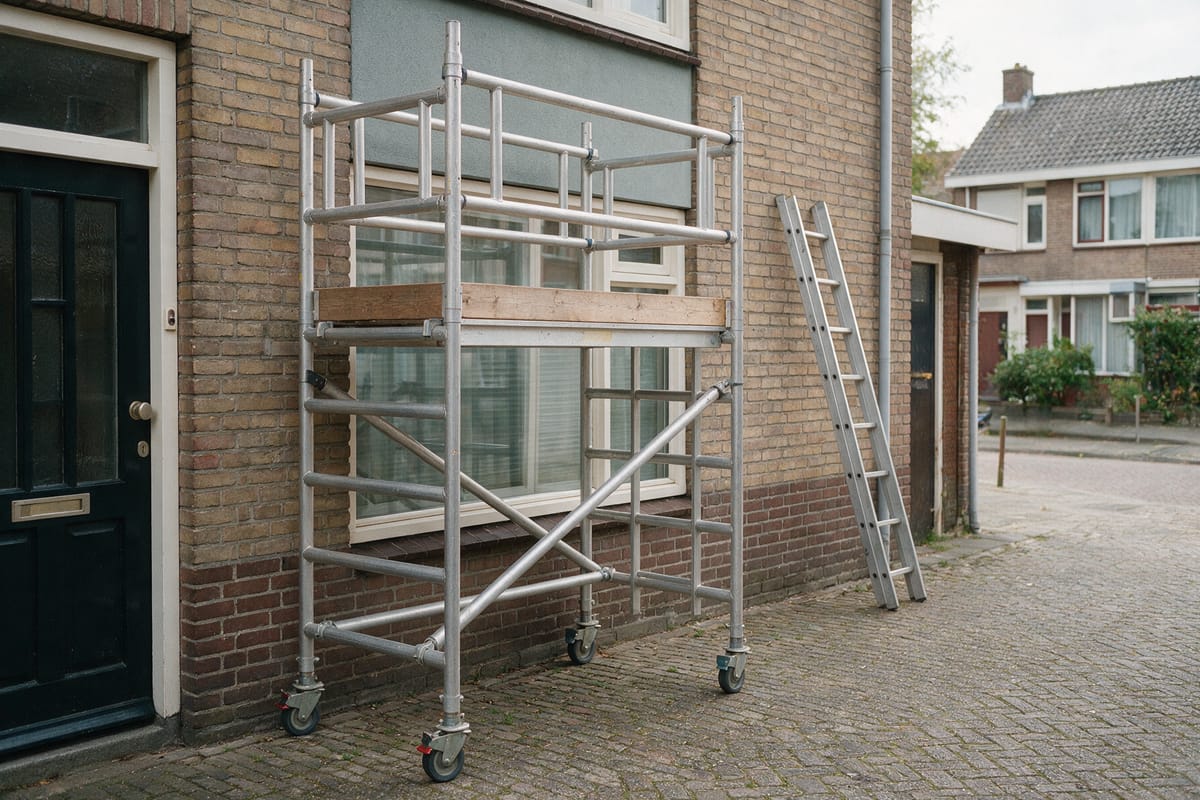
- Mobile scaffold. For work that takes longer in one place or along a row, such as painting a facade or replacing window frames. You have a floor under your feet and a guardrail around you.
- Aerial work platform. When you move often, the ground does not allow a scaffold, or the height gets too great. Have it operated by someone trained to use it.
- Stepladder with a platform. For short indoor work at limited height. You stand on a platform instead of a rung.
- Ladder. For short, light work within arm's reach, and as access to a higher level.
If it is going to be the ladder
Then the rules of article 7.23a apply: firm, level ground, measures against slipping, and when used for access, extending at least 1 metre above the landing. How to do that is in securing a ladder and a ladder on sloping or soft ground. Check the ladder before use with the thirty-second ladder check.
Frequently asked questions
How high may you work on a ladder?
The law sets no maximum. Dutch construction uses 7.5 metres standing height as the upper limit, and between 5 and 7.5 metres only after discussion and with extra measures.
May I use a ladder because a scaffold is too expensive?
No. Cost is not a reason to choose less safe equipment. It is only allowed with low risk combined with short work or a location that allows nothing else.
How long may you stand on a ladder?
According to the Arbouw table, under 2 hours for the whole job, and no more than an hour per person in total. Beyond that you need other equipment.
Does this apply in Belgium too?
The legal text is almost the same, but the Belgian rules name no numbers. There you record in the risk assessment why a ladder is acceptable.
Sources
- Dutch Working Conditions Decree (Arbobesluit), articles 7.23 and 7.23a
- Arbouw: The ladder as a workplace? When yes, when no (Dutch)
- Belgian Code on well-being at work, Book IV, Title 5, article IV.5-4 (Dutch)
This article is a practical explanation, not legal advice. Sources checked on 24 September 2026.