
Ladder safety
A ladder on sloping or soft ground: how to keep it stable
· 4 min read
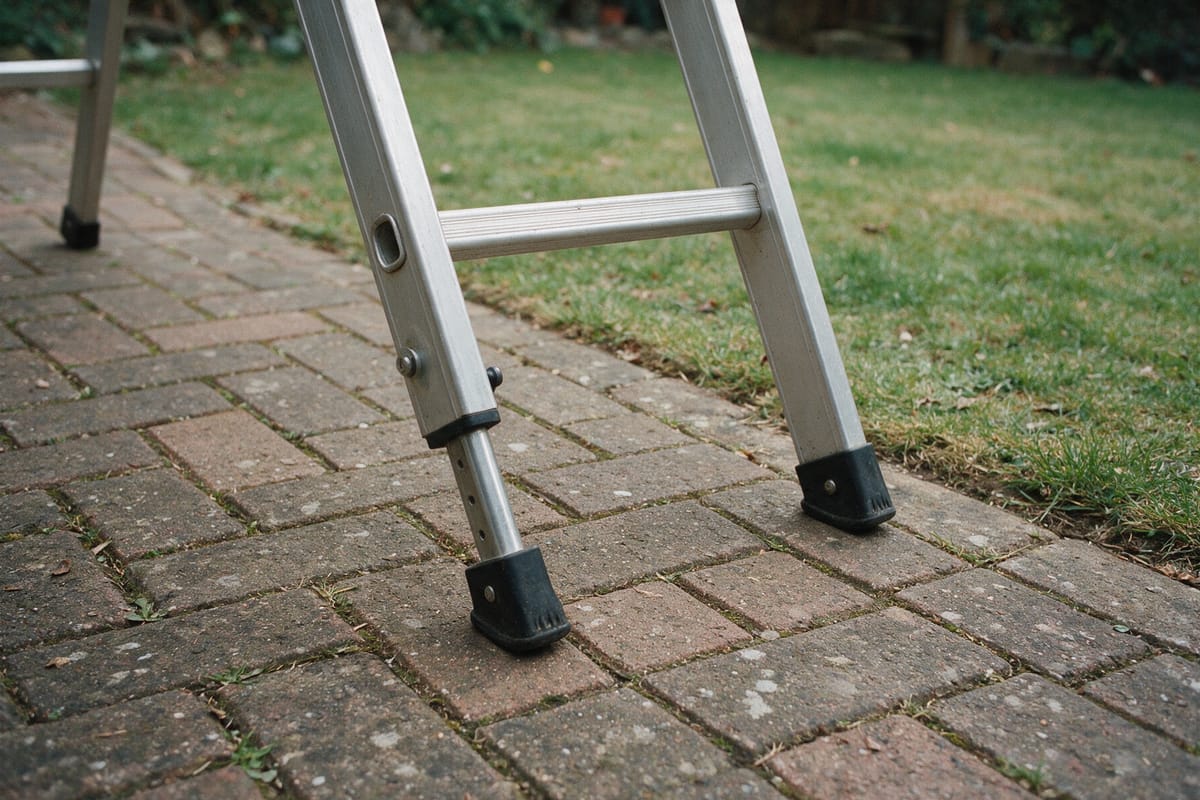
The rungs must stay level and the feet must rest on firm ground that does not move. Article 7.23a of the Dutch Working Conditions Decree requires exactly that. On a slope or stairs you use adjustable legs or a leveller, on soft ground a wide base plate, and you never pack it up with bricks, boards or a crate.
What the law asks
Article 7.23a of the Dutch Working Conditions Decree is very concrete here: the feet of a portable ladder rest on stable, firm and immovable ground of sufficient size, so that the rungs stay horizontal. In Belgium almost the same is in article IV.5-5 of the Code on well-being at work.
Why crooked is so dangerous
If one foot stands lower than the other, the ladder leans. Your weight then pushes not straight down but slightly sideways, and every sideways movement makes it worse. On soft ground one foot sinks during the work, and exactly the same happens while you are already at the top.
By type of ground
| Ground | What goes wrong | What you do |
|---|---|---|
| Slope, kerb or stairs | the feet are at different heights | adjustable legs or a leveller made for the ladder |
| Grass, sand or soil | a foot sinks in | a wide base plate, and keep checking during the work |
| Gravel | the foot shifts and sinks at an angle | scrape the gravel away down to a firm layer, or use a base plate |
| Smooth tiles, wet floor | the foot slides away | anti-slip feet in good condition, and secure the foot |
| Leaves, moss or ice | slippery without you seeing it | clean first, and if you cannot, do not |
What you never put under a ladder
A brick, a board, a bucket or a crate. Arbouw names it in its guidance too: no slope, no soft, uneven or slippery ground, and not on a table or crate. Loose packing shifts or breaks as soon as weight comes on it, and you only notice when you are at the top.
Adjustable legs and levellers
If you often work on kerbs, stairs or embankments, a ladder with adjustable legs or a separate leveller is the best investment. When buying, look at three things:
- the leg locks and cannot slide in under load;
- the height difference it can bridge suits your work;
- the leveller is made for your type of ladder.
After adjusting, check that the rungs really are level. Some ladders have a built-in spirit level; a level on a rung works too. Then check the angle again: about 75 degrees, as explained in securing a ladder.
Frequently asked questions
May you put a board under a ladder foot?
No. A loose board can shift, tilt or break. Use adjustable legs or a leveller that belongs to the ladder.
How do you set up a ladder on stairs?
Only with a ladder with adjustable legs or with a leveller. Both feet must be firm and the rungs level. If that is not possible, use a stair scaffold.
May a ladder stand on grass?
Only if the feet do not sink. On soft ground you use a wide base plate, and you check during the work that the feet are not sinking after all.
What is the right angle on a slope?
The same as always, about 75 degrees. A slope changes the angle if you are not careful, so measure again after adjusting the legs.
Sources
- Dutch Working Conditions Decree (Arbobesluit), article 7.23a
- Belgian Code on well-being at work, Book IV, Title 5, article IV.5-5 (Dutch)
- Arbouw: The ladder as a workplace? When yes, when no (Dutch)
This article is a practical explanation, not legal advice. Sources checked on 24 September 2026.