Safety
Fall protection: from what height is it required?
· 5 min read
This explains the rules that apply in the Netherlands and Belgium.
In the Netherlands from a possible fall of 2.5 metres, and lower as soon as there is an opening in the floor or anything else that makes a fall worse, such as water or traffic below. Belgian rules for work at height set no fixed height: the risk assessment decides. In both countries, a guardrail or scaffold comes before a harness.
The Netherlands: 2.5 metres, but that is a floor
The rule is in article 3.16 of the Dutch Working Conditions Decree (Arbobesluit). It says there is fall danger in any case when you can fall 2.5 metres or more. Note those words: in any case. The 2.5 metres is the point where nobody can argue about it any more, not the point below which anything goes.
The same article names two situations with fall danger regardless of height:
- Openings in floors. A cut-out, an open hatch, a stairwell in an extension. Even if you can only fall a metre.
- Circumstances that increase the risk. Think of working above water, next to traffic or above machinery. Arboportaal, the Dutch government's information site, puts it this way: below 2.5 metres too, the employer takes measures when there is a risk of falling.
What you then have to do, in this order
The decree sets a fixed order. You start at the top and only move down a step when the step above really is not possible.
- A safe working floor. A scaffold, staging, platform or floor to work from.
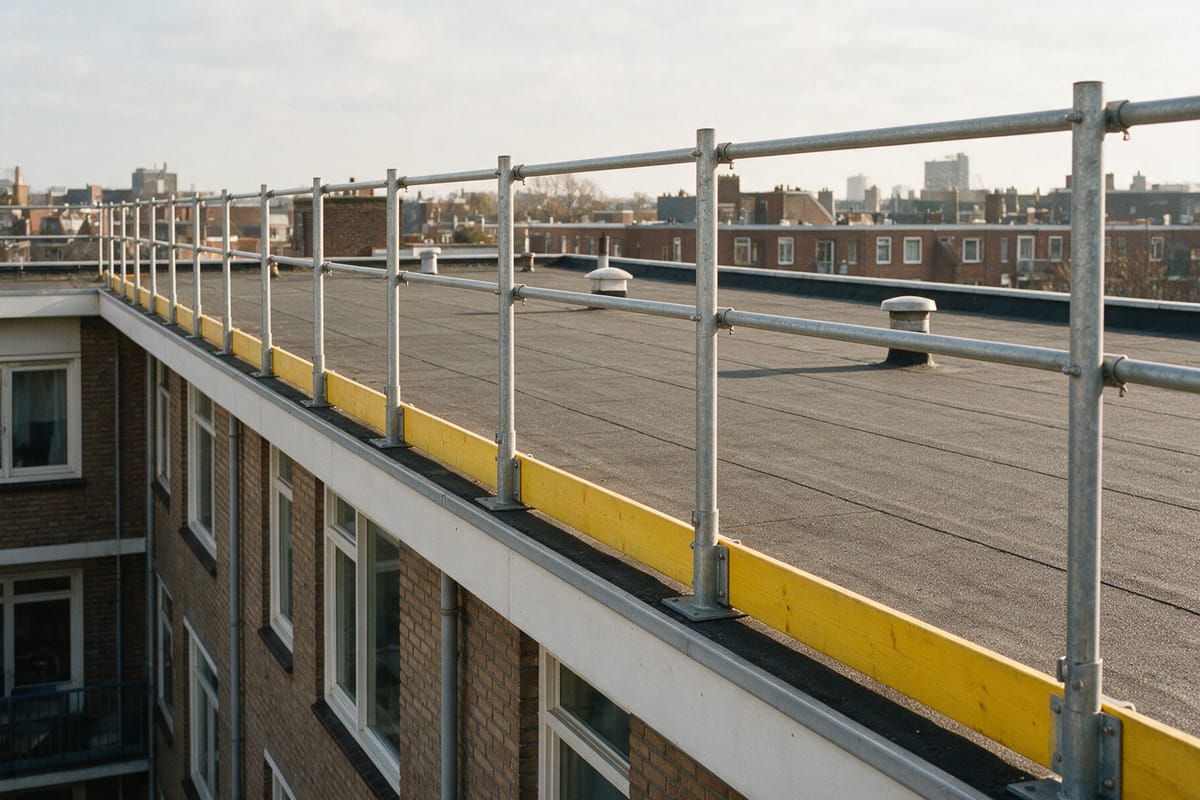
- Edge protection. Barriers or guardrails. They only count if they protect up to at least 1 metre above the working surface.
- Safety nets. Only when a working floor or guardrail is not or only partly possible, or when installing it is more dangerous than the work itself.
- Personal fall protection. A harness with a lanyard on an anchor point that can hold the fall. This is the last step, not the first.
The law states explicitly that measures that protect everyone come before measures that protect one person. A guardrail works when someone is tired or in a hurry. A harness only works when it is worn properly and clipped on.
And on a ladder?
Here is an exception many people do not know. The fourth paragraph of article 3.16 says the duty to provide a working floor or guardrail does not apply where using a ladder is permitted. When that is the case is set out in article 7.23: only when a safer means is not justified because the risk is low, and the work is short or the location allows nothing else.
So on a three-metre ladder you do not need a guardrail. But the ladder itself then has to be the right choice, and there are clear limits for that. They are in our article on when to choose a ladder, mobile scaffold or aerial platform.
Does this apply to self-employed workers too?
Yes. Article 9.5 of the decree lists the rules a self-employed person must follow themselves. Article 3.16 is on that list, and so are the rules for ladders and scaffolds in articles 7.23 to 7.23d. If you work alone, you are your own employer for these rules.
Belgium: no number, but an order
The Belgian rules for temporary work at height are in Book IV, Title 5 of the Code on well-being at work. That text sets no height above which protection becomes mandatory. Online you will often read 2 metres or 2.5 metres, but those numbers do not come from this title of the Code.
What it does say is the same order as in the Netherlands: the employer provides protection against falls, and collective protection comes before personal protection. Whether there is a fall risk follows from the risk assessment, and you need to be able to show it. How that works in practice is in our article on the Belgian Code.
Video: Falling short (Napo, EU-OSHA)
Frequently asked questions
Is fall protection never required below 2.5 metres?
It is. With an opening in the floor, or with circumstances that make a fall worse, such as water or traffic below, it applies lower too. The 2.5 metres is the limit above which it always applies.
Is a harness enough?
Only when a working floor, guardrail or safety net is not or only partly possible, or when installing one is more dangerous than the work. And a harness only works with an anchor point that can hold the fall.
How high does a guardrail have to be?
In the Netherlands a barrier or guardrail protects up to at least 1 metre above the working surface, or meets the requirements for floor edges in the Dutch building regulations (Besluit bouwwerken leefomgeving).
Who is responsible?
The employer, and a self-employed worker for themselves. In Belgium the duty also lies with the employer, who has to support it in the risk assessment.
Sources
- Dutch Working Conditions Decree (Arbobesluit), articles 3.16, 7.23 and 9.5
- Arboportaal: working at height (Dutch)
- Belgian Code on well-being at work, Book IV, Title 5 (FPS Employment, Dutch)
This article is a practical explanation, not legal advice. Sources checked on 24 September 2026.