
Safety
Working on a flat roof: when do you need edge protection?
· 6 min read
This explains the rules that apply in the Netherlands and Belgium.
If you can fall 2.5 metres or more, the fall danger has to be removed: first with a guardrail, and only with a line if that is not possible. The Dutch roofing sector has worked this out in distances from the roof edge. Beyond 4 metres a visible marking is enough, between 2 and 4 metres a barrier at 1 metre height, and within 2 metres a guardrail is needed, except for short work such as an inspection.
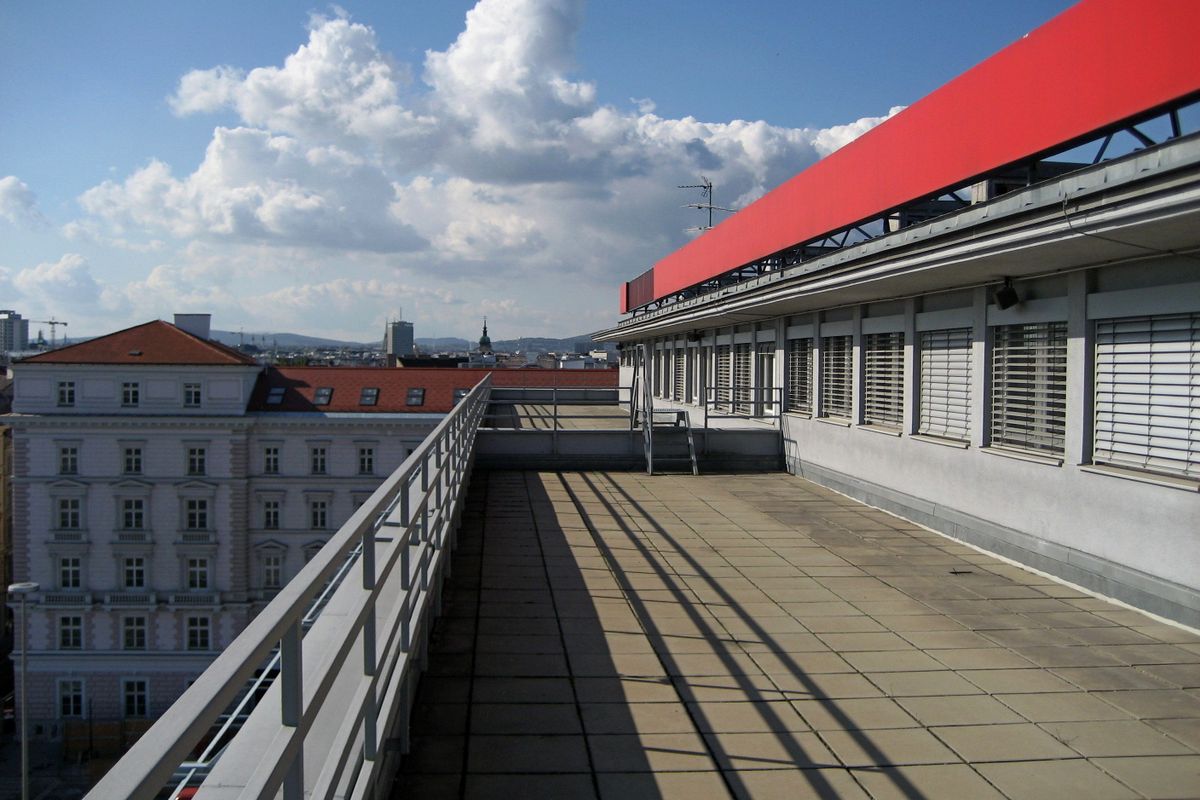
What the law says
Article 3.16 of the Dutch Working Conditions Decree (Arbobesluit) says there is fall danger in any case when you can fall 2.5 metres or more, at openings in floors and in circumstances that increase the risk. The roof of an extension or garage soon reaches that height.
The law also gives the order. First a safe working floor or an effective guardrail: it protects up to at least 1 metre above the working surface. Only when that is not possible, or only partly, or when fitting it is more dangerous than the work itself, do safety nets and harnesses with lanyards come into view. Measures that protect everyone take priority over measures that protect one person. The full order is in our article on fall protection.
What the law does not say is how close to the edge you may come. The sector has worked that out itself.
The roofers' scheme: distance from the edge
Employers and employees in the Dutch roofing sector have drawn up a scheme in their health and safety catalogue for flat roofs (Arbocatalogus Platte Daken). It starts with one question: are there permanent provisions at the roof edge, the rooflights and the openings? Then nothing extra is needed. If not, the distance from the fall hazard decides what you do.
| Distance from the edge, rooflight or opening | What is needed |
|---|---|
| More than 4 metres | A visible marking at least 4 metres from the fall hazard, in a colour that clearly differs from the rest of the roof, for as long as the work lasts |
| Between 2 and 4 metres | A physical barrier at least 2 metres from the fall hazard, at a height of 1 metre. For example tape, chain or rope |
| Closer than 2 metres, ordinary work | Collective provisions, such as a guardrail along the edge |
| Closer than 2 metres, short work | A line: first a fixed line that keeps you from reaching the edge, and only if that is not possible a line that arrests a fall |
So barrier tape is not edge protection. It is a boundary that keeps you at a distance, and it only works if it stands at least 2 metres from the edge.
The scheme is an agreement within the roofing sector. If you work on a flat roof in another trade, article 3.16 remains the rule and the scheme is a useful yardstick.
What counts as short work?
The catalogue names five kinds:
- roof inspections;
- roof surveys;
- periodic cleaning maintenance;
- repairs in which nothing is replaced;
- fitting and removing the collective provisions themselves.
Work that is not on this list, such as laying a new roof covering, is not short work. Within 2 metres of the edge it calls for collective provisions.
Rooflights and openings
The scheme does not only apply to the roof edge. Rooflights count just the same, and under the law an opening in the roof is a fall hazard however high the roof is. For openings the catalogue gives two solutions:
- Covering with material you can walk on, fixed with nails or screws and marked with a colour or a cross.
- A rail directly around it, at least 1 metre above the working surface, with an intermediate rail so that no gap is larger than 47 centimetres, and a toe board of at least 15 centimetres if there is no upstand of that height.
Working on a line: what to watch
A line is the last step, not the first. When it comes to that, the catalogue asks for this:
- Anchor points comply with EN 795 or EN 17235 and have been inspected as the supplier prescribes. Check that before you start.
- The harness complies with EN 361 and fits your build and weight.
- There is always a second person who is trained to rescue a colleague after a fall.
- You clip on as soon as you step onto the roof.
- With an energy-absorbing lanyard you calculate how much clear space is needed below you. In practice that is usually at least 6 metres.
That last point is often forgotten. On an extension 3 metres high, that space is not there. That is why a fixed line, which keeps you away from the edge, comes first.
How do you get onto the roof?
On a flat roof a ladder is in principle only the way up, for a height difference of 7.5 metres at most. The decree requires that stepping from the ladder onto the roof creates no extra risk of falling. The Volandis guidance sheet on pitched roofs adds measurements: the ladder extends 1 metre above the surface you step onto, is anchored at the top, and you step off sideways rather than over the top. How to secure a ladder is covered in our article on preventing slipping.
Rain, ice and wind
Under the decree, temporary work at height is only carried out when the weather does not endanger safety. The catalogue asks you to check every day before starting whether the roof can be walked on: rain, snow and ice make a roof slippery, and strong wind blows people and material over. When the wind is too strong, work stops. What that means for ladders is in our article on ladders and wind.
Belgium
In its title on work at height, the Belgian Code gives no distances and no height. It does give the same order: the employer provides protection against falling and gives collective protection priority over personal protection. What a particular roof needs follows from the risk assessment. More in our article on the Code.
Frequently asked questions
From what height is roof edge protection required?
There is fall danger in any case from a fall height of 2.5 metres. At an opening in the roof, or with something that increases the risk such as water or traffic below, also lower.
Is barrier tape enough?
Only if you work between 2 and 4 metres from the edge, and the tape hangs at least 2 metres from the edge at a height of 1 metre. Closer to the edge you need collective provisions such as a guardrail, or a line for short work.
How high does a guardrail have to be?
The law asks for protection up to at least 1 metre above the working surface. For openings the catalogue adds an intermediate rail, so that no gap is larger than 47 centimetres, and a toe board of 15 centimetres.
I only need to clean a drain. Do I need a guardrail?
Periodic cleaning maintenance counts as short work. If there is no permanent provision and the drain is within 2 metres of the edge, you work on a line attached to an inspected anchor point, preferably a fixed line that keeps you from reaching the edge.
May I go onto the roof alone when working on a line?
No. For work on a line the catalogue always asks for a second person who is trained to rescue.
Sources
- Dutch Working Conditions Decree (Arbobesluit), articles 3.16 and 7.23
- Arbocatalogus Platte Daken: fall danger, with the scheme for work on flat roofs (updated December 2025, in Dutch)
- A-blad Hellende daken (Volandis, fourth edition 2018, in Dutch), section 3.4.8 on the ladder as access
- Code on Well-being at Work, Book IV, Title 5 (Belgian Federal Public Service Employment)
This article is a practical explanation, not legal advice. Sources checked on 8 October 2026.