
Safety
Working on a pitched roof: scaffold, edge protection or line?
· 7 min read
This explains the rules that apply in the Netherlands and Belgium.
A pitched roof calls for a scaffold or roof edge protection along the gutter. The Dutch construction sector has agreed that this is required as soon as the work takes more than 3 person-hours per dwelling and per roof face. Only for one-off shorter work, and if a safe working floor is technically not feasible, may a line be used. When wind force 6 is expected, ladders and aluminium mobile towers are out; at wind force 7 work on the roof stops.
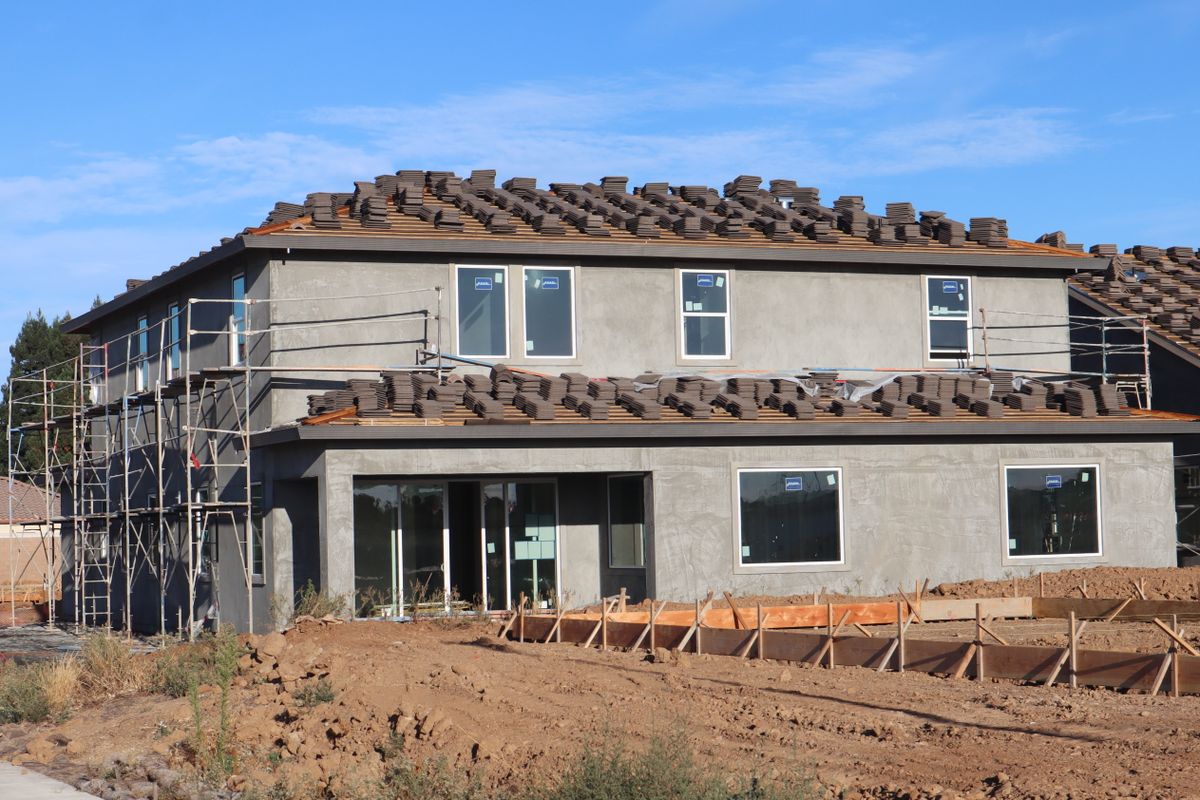
When is a roof pitched?
The Volandis guidance sheet on pitched roofs (A-blad Hellende daken), in which employers and employees in Dutch construction have laid down their agreements, draws two lines. A roof with a pitch of up to 10 degrees counts as a flat roof. Above 75 degrees it is called facade cladding. Everything in between is a pitched roof. Different agreements apply to flat roofs: see our article on the flat roof.
The main rule: a scaffold or edge protection
The law is the same as on any other roof. Article 3.16 of the Dutch Working Conditions Decree (Arbobesluit) asks first for a safe working floor or guardrail where there is fall danger, and gives measures that protect everyone priority over measures that protect one person.
The guidance sheet makes that concrete with a time limit:
- More than 3 person-hours per dwelling and per roof face: collective fall protection, meaning a scaffold or roof edge protection.
- Several short jobs in one project: collective fall protection as well, however short each job is.
- One short job of less than 3 person-hours: a line may be considered, but only if there are technical obstacles to creating a safe working floor in another way. An elevating work platform with a basket also counts as a safe working floor.
Person-hours add up: two people working two hours on the same roof face make four person-hours together. A roof face is at most one dwelling in size. The front and back of the roof are two roof faces.
What counts as roof edge protection?
On the gutter side the guidance sheet lists these solutions, in order of preference:
- a scaffold floor with guardrails;
- a walkway bridge along the eaves that is suitable as fall protection;
- a mast climbing work platform;
- a prefabricated gutter scaffold on brackets fixed in the facade;
- railing on the gutter edge, only for roof pitches up to 60 degrees;
- a safety net at least 1.80 metres high, measured at right angles to the roof, or 2 metres horizontally beyond the gutter;
- a gutter scaffold made of hanging brackets and boards, only up to a working height of 6 metres.
The rail is at least 1 metre high, with a double rail and a toe board of 15 centimetres, and no gap larger than 47 centimetres anywhere. For tiled roofs the scaffold floor lies at most half a metre below the gutter. If the protection rests in the gutter, it must be demonstrable that the gutter is strong enough.
If the ridge lies more than 5 metres above the eaves, measured vertically, intermediate protection on the roof face is needed in addition to the protection at the gutter.
Short work on a line: the order
With a line there is an order too.
- Work restraint. A harness with a short, fixed line without an energy absorber. The line is of such a length that you can never fall over the edge of the roof.
- Fall arrest. Only if work restraint is technically not possible: a harness with a lanyard and energy absorber, which arrests a fall.
What you attach the line to matters just as much:
- to an approved safety system or an anchor point fixed to the building;
- or to a roof ladder that is itself anchored strongly enough;
- never to the tiling battens. The guidance sheet expressly forbids that on tiled roofs.
Anchor points belong to the building. The owner has to be able to show that they are safe to use, for example with a recent inspection certificate. Ask for it before you go onto the roof. If you work with a harness, the emergency response plan has to cover that too.
The roof ladder
A roof ladder lies on the roof face. It lets you walk on the roof more safely and work in a better posture. The guidance sheet sets tight limits:
- only for work lasting 1 hour at a stretch at most;
- the work is within 1 metre of the ladder;
- both feet stay on the ladder;
- there is collective fall protection, or you are secured separately to an anchor point;
- the ladder is secured to hooks that reach over the ridge, or to a sound anchor point complying with EN 517. Standing it in the gutter at the bottom is only allowed if the gutter construction permits it.
How do you get onto the roof?
For tiled roofs the best solution, according to the guidance sheet, is to make the roof accessible from inside, through a roof hatch or dormer. If it has to be a ladder, these measurements apply:
- a ladder bridges 7.5 metres at most;
- it extends 1 metre above the surface you step onto;
- it stands on ground that bears the load, cannot sink or slip, and is anchored at the top;
- you step off sideways, or use a ladder walk-through.
More on the ladder against the gutter is in our article on the gutter.
Only inspecting or repairing the gutter
The guidance sheet has its own rule for this. A gutter up to 5 metres high may be inspected and repaired standing on a ladder, if:
- the ladder can be placed properly against the gutter and is secured against slipping at the bottom and the top;
- the total working time is no more than 2 hours;
- you reach no further than one arm's length;
- the gutter is stable enough not to deform.
If that does not work, or the gutter is higher, the starting point of the guidance sheet applies: work from a scaffold or another safe workplace.
Solar panels, roof windows and dormers
For work on a single building the guidance sheet names a few fixed points:
- a safe working floor with fall protection along the gutter;
- the rail is 1 metre longer on each side than the strip of roof you work on;
- components heavier than 23 kilos or larger than 1 by 2 metres go up mechanically;
- electrical work is for someone trained for it.
Weather and wind
- Wind force 6 or more expected: work on aluminium mobile towers stops and ladders are not used.
- Wind force 7 on the roof: work on the roof and hoisting stop.
- Rain, snow, ice or frost: the roof becomes slippery and the chance of slipping increases.
The guidance sheet asks you to agree in advance at which wind force work stops. On the coast and near tall buildings it can blow harder than expected. More on wind in our article on ladders and wind.
Belgium
In its title on work at height, the Belgian Code gives no hours and no height. It does give the same order: the employer provides protection against falling and gives collective protection priority over personal protection. What a particular roof needs follows from the risk assessment. More in our article on the Code.
Frequently asked questions
May I replace a few roof tiles without a scaffold?
Only if it is a one-off job of less than 3 person-hours on that roof face, and a safe working floor is technically not feasible. Then you work on a line attached to a sound anchor point. If there are several jobs in one project, collective fall protection is required.
May I attach my line to the tiling battens?
No. The guidance sheet says expressly that on tiled roofs the battens may not be used to attach a safety line.
How long may I work on a roof ladder?
1 hour at a stretch at most, with the work within 1 metre of the ladder and both feet on the ladder.
At what wind force do you stop?
When wind force 6 is expected you no longer use ladders or an aluminium mobile tower. At wind force 7 on the roof, work on the roof stops.
Does this apply to the self-employed?
The law does: article 9.5 of the decree names article 3.16 and articles 7.23 to 7.23d as rules a self-employed person must follow. The guidance sheet is an agreement between employers and employees in construction, intended for all roofing companies in the Netherlands.
Sources
- Dutch Working Conditions Decree (Arbobesluit), articles 3.16, 7.23 and 9.5
- A-blad Hellende daken (Volandis, fourth edition 2018, in Dutch)
- Code on Well-being at Work, Book IV, Title 5 (Belgian Federal Public Service Employment)
This article is a practical explanation, not legal advice. Sources checked on 8 October 2026.