
Safety
Roof lifeline: when is it allowed, and when not?
· 6 min read
A lifeline is personal fall protection, and by law it only comes in when a guardrail, scaffold or roof edge protection is not possible. On a flat roof, a line within 2 metres of the edge is only allowed for short work. On a pitched roof only for a one-off job of less than 3 man-hours. And never without an inspected anchor and a colleague who can rescue you.
What is a lifeline?
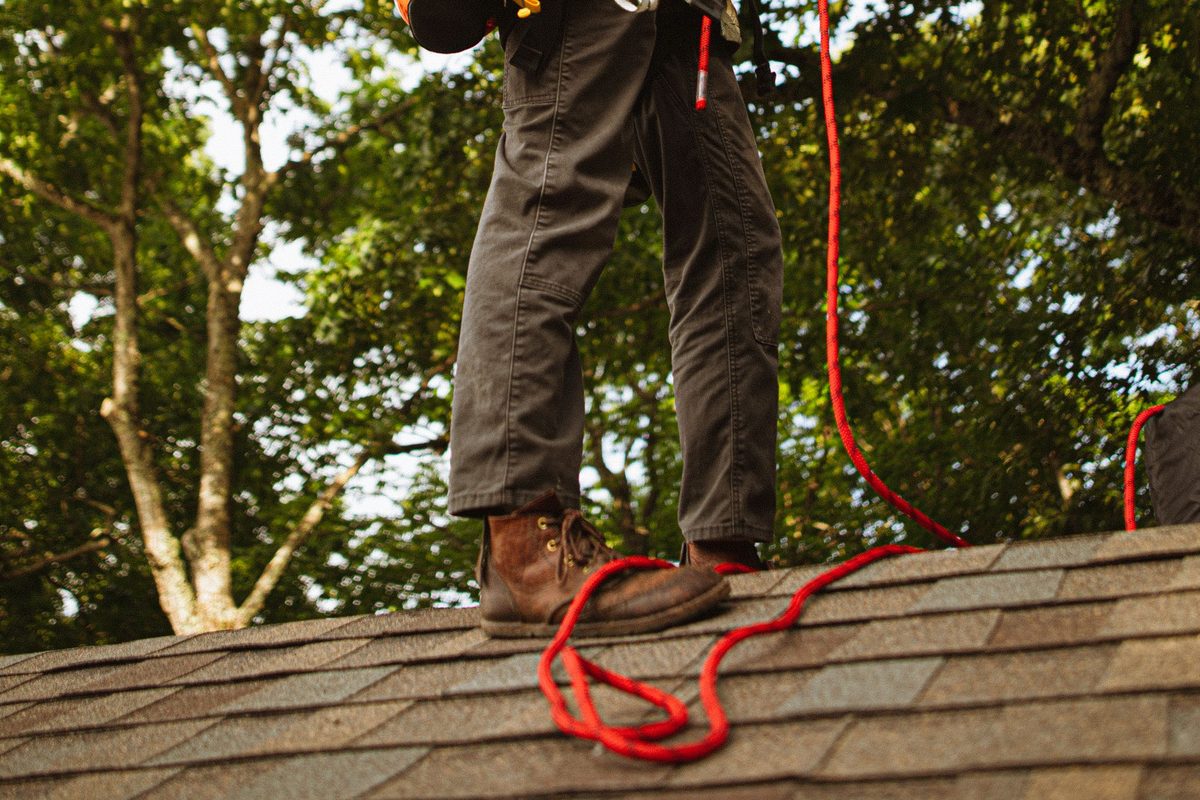
A lifeline is a cable or rail fixed to the roof. You clip on with a harness and can move along the line without unclipping. In the European standard for anchor devices, EN 795, this is a type C anchor device: a horizontal line between fixed points. A single anchor point to which you attach one lanyard is a different type.
Important to know: a lifeline only protects the person attached to it, and only when they are clipped on properly. That is why it sits at the very bottom of the law's list.
What the law says: edge first, line last
Article 3.16 of the Dutch Working Conditions Decree (Arbobesluit) sets a fixed order where there is a risk of falling:
- a safe working floor, such as a scaffold;
- a barrier or guardrail, in other words roof edge protection;
- safety nets;
- only then personal fall protection, such as a harness on a line.
You only move down a step when the step above is not possible, or only partly, or when installing it is more dangerous than the work itself. Measures that protect everyone come before measures that protect one person. "There is already a lifeline on the roof" is therefore no reason to skip roof edge protection when the work takes longer.
Flat roof: only for short work near the edge
The Arbocatalogus Platte Daken, the agreements of the Dutch roofing sector, looks at the distance to the edge:
- more than 4 metres from the edge: a visible marking is enough;
- between 2 and 4 metres: a physical barrier 2 metres from the edge;
- within 2 metres, normal work: collective measures, such as roof edge protection;
- within 2 metres, short work: a line.
Short work, according to the Arbocatalogus, means roof inspections, roof surveys, periodic cleaning, repairs where nothing is replaced, and installing and removing the collective measures themselves. Laying a new roof covering or installing solar panels is not on that list. The full scheme is in our article on flat roofs.
Pitched roof: only for one short job
For pitched roofs, the Dutch construction sector's guidance sheet (A-blad Hellende daken) says: for more than 3 man-hours per roof surface, or for several short jobs in one project, you need a scaffold or roof edge protection. A line may only be considered for a single job of less than 3 man-hours, and only if a safe working floor is technically not possible. Man-hours add up: two people working two hours is four man-hours. More in our article on pitched roofs.
Better not to fall than to be caught
There is an order on a line too. Best is a line so short that you cannot even reach the edge. This is called work restraint. You cannot fall. Only if that is technically impossible do you choose a line with an energy absorber that catches a fall.
Catching a fall takes space. The line stretches and the energy absorber tears open, and in practice you usually need at least 6 metres of clear space below you. On an extension or garage 3 metres high, you hit the ground before the line stops you. Only work restraint works there.
Five conditions when working on a line
- An inspected anchor point or lifeline. The Arbocatalogus requires anchor points to NEN-EN 795 or NEN-EN 17235, inspected as the supplier prescribes. The EN 365 standard and manufacturers give an inspection by a competent person at least once every 12 months. Ask the building owner for the inspection certificate before you go onto the roof.
- Never to whatever happens to be there. No roof battens, gutters, aerials or pipes. The A-blad explicitly forbids roof battens.
- A harness that fits. To NEN-EN 361, adjusted to your build and weight.
- Clip on as soon as you step onto the roof. Not only at the edge.
- Never alone. There is always a second person trained to rescue you after a fall. Hanging in a harness for long can make you seriously ill, so the rescue must be quick.
When do you choose roof edge protection?
In most cases. As soon as the work is not a short inspection or small repair, or when several people work on the roof at once, a guardrail along the edge protects everyone at the same time, including whoever is not paying attention for a moment. It does not have to be a fixed structure: there are temporary systems you clamp on or place with counterweights. See our roof edge protection for flat and pitched roofs.
Belgium
The Belgian Code on well-being at work gives no distances or hours in its title on work at height. It does give the same order: collective protection comes before personal protection. When a lifeline is justified is recorded by the employer in the risk analysis. More in our article on the Belgian Code.
Frequently asked questions
Is a roof lifeline mandatory?
Dutch law does not require a lifeline. It requires protection against falling, with priority for a working floor or guardrail. A lifeline is a possible solution for short work when those first steps are not possible.
How often must a lifeline be inspected?
As the supplier prescribes. The EN 365 standard and manufacturers give at least once every 12 months, by a competent person. After a fall, the system is taken out of use until it has been inspected again.
Can I work alone on a lifeline?
No. The Arbocatalogus Platte Daken always requires a second person trained in rescue.
How much space do I need below me?
With a line with an energy absorber, in practice usually at least 6 metres. If you do not have that, use a short line that keeps you from reaching the edge.
What is the difference between a lifeline and an anchor point?
An anchor point is a single fixed point. A lifeline is a cable or rail between fixed points along which you can move without unclipping. EN 795 calls the lifeline type C.
Sources
- Dutch Working Conditions Decree (Arbobesluit), articles 3.16 and 9.5 (in Dutch)
- Arbocatalogus Platte Daken: Valgevaar (in Dutch)
- A-blad Hellende daken (Volandis, in Dutch)
- EN 795, Personal fall protection equipment: anchor devices; EN 365, use, maintenance and periodic examination
- Belgian Code on well-being at work, Book IV, Title 5 (in Dutch)
This article is a practical explanation, not legal advice. Sources checked on 6 November 2026.
In our shop
- Fall protectionTemporary edge protection for flat and pitched roofs, spare parts and personal fall protection kits.View the range
- Mobile scaffold towersAluminium scaffold towers from Euroscaffold and Alumexx in various working heights, parts listed per set.View the range
- LaddersAluminium combination, extension, single, folding and telescopic ladders, with working height and weight.View the range